Home / TVS & ESD Diodes
TVS diodes & ESD protection diodes
LineWeforsemi own brand
Peak pulse powerUp to 1,600 W (VCTU7V550F3S)
ESD ratingIEC 61000-4-2 ±30 kV (VCTB3V32515LC)
Smallest package0.6 × 0.3 × 0.3 mm
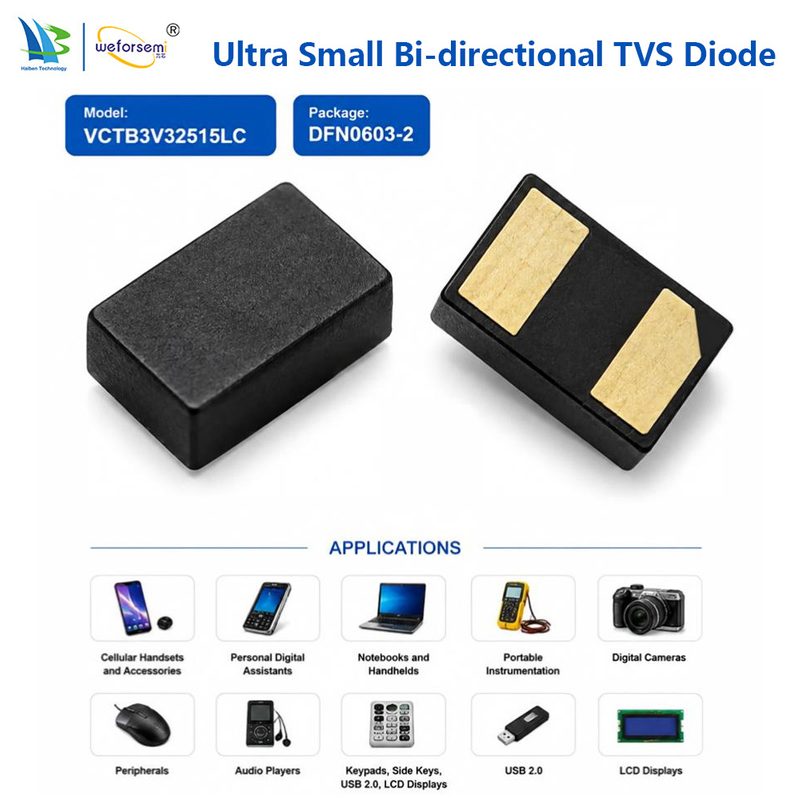
A transient voltage suppressor, usually shortened to TVS diode, is the component that stands between a transient on a data line, a power rail or an interface and the device behind it. This page sets out what the device class does, the protection parts stocked by Shenzhen Haiben Electronic Technology Co., Ltd., and the practical choices that face purchasing and hardware engineers. Haiben has supplied electronic components from Shenzhen since 2013, and also offers its own-brand semiconductor line, the Weforsemi line, through a wholly-owned subsidiary.
What a TVS diode protects against
Transient voltage suppression diodes, also called transient voltage suppressors, clamp brief overvoltage events before the energy reaches sensitive circuitry. The events in scope are standard ones: electrostatic discharge from handling and from connectors, switching transients on power rails, and the surge currents that coupling injects into cables. A TVS diode responds quickly, presents high impedance at normal working voltage, and changes state to divert the transient to ground when a defined threshold is exceeded. Interface ports and power inputs are where damage is most often reported, and they are where most of the protection range is placed.
The stocked protection range
The catalogue carries a protection range that spans small ESD devices to higher-power discrete TVS parts. All of the following are sold through Haiben's SMD diodes category:
- VCTB3V32515LC — DFN0603-2L, bidirectional, 3.3 V operating voltage, 80 W peak pulse power, 8 A peak pulse current, IEC 61000-4-2 rated at ±30 kV air and ±30 kV contact; very low capacitance and nA-level leakage, protecting one data or power line.
- VCTU7V550F3S — DFN1610-2L (1.6 × 1.0 × 0.5 mm), 7 V working voltage, 1600 W peak pulse power, 80 A peak pulse current, 2-pin leadless, protecting one data or power line.
- VCLT550-YW — SOD-323, 350 W (8/20 µs) peak pulse power, low clamping voltage, RoHS compliant, matte tin lead finish (Pb-free).
- VCTB5V0P215YW — DFN0603-2L, fast response, low operating voltage, for protecting sensitive semiconductor components from ESD and transients.
- VCTB24V0P415FSL — DFN0603-2L, a 24 V TVS diode for ESD circuit protection.
Selection starts with the working voltage of the line, then the expected peak pulse power or current, then capacitance where signal integrity matters. Our TVS diode selection guide walks through that sequence. Bidirectional parts are a direct fit for lines that swing in both directions, such as AC-coupled or differential signals, while unidirectional parts suit DC rails where clamping on one polarity is intended. Several stocked devices are documented as protecting a single data or power line, which helps when counting positions on a BOM.
ESD protection diodes and interface protection
In this catalogue, ESD protection diodes are the low-capacitance branch of the TVS diode family. Low capacitance matters on high-speed data and on high-impedance measurement inputs, where excess capacitance would round edges and distort signals. The VCTB3V32515LC, built with monolithic silicon technology for fast response and low ESD clamping voltage, is described by its manufacturer as a fit for protecting voltage-sensitive data and power lines; the 24 V VCTB24V0P415FSL covers the same role on higher-voltage ports. Interface protection is generally the first section of a schematic and the easiest to add late, so it is worth reserving footprints early. Where a design protects a battery-powered product, protection is usually reviewed alongside the battery protection ICs page, since one guards against transients at the connector and the other against cell-level faults.
Bidirectional or unidirectional — and the USB case
A bidirectional TVS diode clamps in both polarities, so a single part protects a signal that alternates around zero. A unidirectional diode is referenced to ground and is the simpler choice for a positive supply rail. The USB case shows why the choice matters: USB connectors carry VBUS and data pairs on adjacent contacts, so a plugged or unplugged cable can push a transient from one line to another in either direction. Working voltage is set with margin above VBUS, and peak pulse current follows from the ESD severity expected at the connector. Parts such as the VCTB3V32515LC and the VCTB5V0P215YW are 0603-footprint devices rated for exactly these low-capacitance data lines, which is why they fit neatly at the connector end of a USB design.
Frequently asked questions
What is the difference between a TVS diode, a transient voltage suppressor and an ESD protection diode?
TVS diode and transient voltage suppressor are the same device class; "TVS diode" is the shorter form. ESD protection diodes are the low-capacitance branch of that family in this catalogue, aimed at data lines and interfaces where signal quality must be preserved.
Can a TVS diode replace a Zener diode on a rail?
They behave differently. A Zener is normally used for continuous regulation within its rating, while a TVS diode is designed to clamp occasional transients and spends most of its life off. For rail clamping under transient conditions the TVS diode is the right device; check the working voltage and the peak pulse figures for your line.
How do I pick between bidirectional and unidirectional parts for a USB data line?
Use a bidirectional part where the line can swing either side of ground, which is the usual situation on USB data pairs during a hot-plug event. Set the working voltage with margin above the interface's normal signalling range, and confirm the part's capacitance is low enough for the data rate.
Representative models — published data
| Model | Package | Published data |
|---|---|---|
| VCTB3V32515LC | DFN0603-2L | Bidirectional; working voltage 3.3 V; peak pulse power 80 W; peak pulse current 8 A; IEC 61000-4-2 ±30 kV air/contact; very low capacitance |
| VCTU7V550F3S | DFN1610-2L | Working voltage 7 V; peak pulse power 1,600 W; peak pulse current 80 A; 1.6 × 1.0 × 0.5 mm |
| VCLT550-YW | SOD-323 | 350 W (8/20 µs) peak pulse power; low clamping voltage; RoHS compliant |
| VCTB5V0P215YW | DFN0603-2L | ESD/TVS protection for sensitive components; fast response; low operating voltage |
| VCTB24V0P415FSL | DFN0603-2L | 24 V TVS diode for ESD circuit protection |
Parameters are quoted from the manufacturer's published product pages. Confirm the full datasheet specification before design-in; ratings are confirmed at quotation.
See also: TVS diode selection guide · Battery protection ICs · SMD diodes