Home / Switching Diodes
Switching diodes
LineWeforsemi own brand
Anchor modelsVC1N4148WB · VC1N4148WTB · VC4148K
PackagesSOD-123 · SOD-523 · LL-34
Forward currentIF(AV) 150 mA (VC1N4148WB)
A switching diode is a small-signal part selected for how fast it changes state and how little charge it stores, not for how much current it can carry. Haiben stocks switching, Schottky, TVS and ESD devices in surface-mount packages from SOD-882 and DFN0603-2L up to SOD-123 and DO-27, alongside the Weforsemi line of own-brand semiconductors. This page explains what these parts do in signal circuits and how to pick between the stocked families.
What switching diodes do in signal circuits
A switching diode conducts in one direction and blocks in the other, and is chosen so that the transition between those two states happens quickly. The defining parameters are reverse recovery time, junction capacitance and reverse leakage; forward current is usually modest. In practice these parts steer logic-level signals, clamp nodes, isolate stages, form simple logic gates, and protect inputs from transients. The same physical device is often called a signal diode when the emphasis is on low-level signal handling rather than switching speed, so this page covers both roles under one heading.
Around the switching function sit two related families. Schottky diodes use a metal-semiconductor junction, which gives a lower forward voltage and no significant minority-carrier storage, so they switch fast and suit clamping and reverse-polarity duties. TVS and ESD diodes are designed to absorb short transients; they are specified by peak pulse power, peak pulse current and clamping voltage rather than by forward current. Choosing between the three is the main decision in most signal-circuit designs.
The stocked switching range
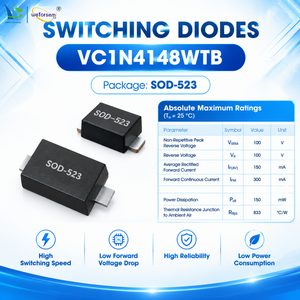
The 1N4148-class role is the centre of the range. The VC1N4148WB in SOD-123 carries IF(AV) 150 mA with reverse leakage of 1 uA, is a fast switching type in a plastic surface-mounted package with two leads, and a platform listing classes it at Vr 75 V. The VC1N4148WTB in SOD-523 is a 100 V fast switching diode in an ultra-small surface-mount package with high conductance, intended for general-purpose switching. The VC4148K in LL-34 is a glass-sealed epitaxial silicon switching diode with a planar structure. Because several manufacturers' 1N4148 variants differ in voltage class and package, the detailed mapping sits on our 1N4148 cross reference page.
Schottky devices fill the low-forward-voltage roles. The VCDS24WZ is a 40 V, 2 A surface-mount Schottky in SOD-123FL. The VCRB520S-30B is a 30 V, 200 mA small-signal SMD Schottky in SOD-523, and the VC103AWSB a 200 mW Schottky in SOD-323 with low forward voltage and marking S4. The VC5819THX in SOD-523 is rated 350 mA and 150 mW, with low forward voltage drop, guard-ring construction for transient protection, low reverse recovery time and low reverse capacitance. The VC520S8-30F in SOD-882 is a 150 mW part with low Vf, and the VC521S6-30X in DFNWB0603-2L is a 100 mA-class versatile Schottky barrier diode with IFSM 0.5 A.
Protection parts complete the picture: the VCTB3V32515LC and VCTB5V0P215YW in DFN0603-2L, the VCTU7V550F3S in DFN1610-2L, the VCLT550-YW in SOD-323 and the VCTB24V0P415FSL, a 24 V TVS diode for ESD circuit protection.
Signal diode duties and package choices
Package choice usually follows the duty. Ultra-small packages such as SOD-882, SOD-523 and DFN0603-2L suit dense boards where the diode sits next to a connector or an IC input and the trace length matters. The DFN0603-2L protection devices are a good example: the VCTB3V32515LC is bidirectional, works at 3.3 V, handles 80 W peak pulse power and 8 A peak pulse current, complies with IEC 61000-4-2 at +/-30 kV air and contact, measures 0.6x0.3x0.3 mm, and adds very low capacitance with leakage in the nA range while protecting one data or power line. Where more energy must be absorbed, the VCTU7V550F3S in DFN1610-2L (1.6x1.0x0.5 mm) is rated 7 V working voltage, 1600 W peak pulse power and 80 A peak pulse current on one line. The VCLT550-YW in SOD-323 offers 350 W peak pulse power at 8/20 us, low clamping voltage and a RoHS compliant matte tin, Pb-free lead finish.
SOD-123 and SOD-323 remain the practical defaults for general switching and clamping, while LL-34 glass parts serve through-hole or mixed assemblies. Larg-er current paths belong to rectifiers rather than signal parts: our fast recovery diodes and the 1N5400 to 1N5408 series, 3 A rectifiers in DO-27 spanning 50 V to 1000 V across the series, cover those duties.
Specifying and cross-referencing
Start from the circuit function, then set the limits. For a switching position, confirm reverse voltage with margin, forward current at the actual operating temperature, reverse recovery time and capacitance against the edge rate in the node. For a Schottky clamp, check forward voltage at the working current and reverse leakage at temperature, since leakage rises quickly and can load a high-impedance node. For protection, match the standoff or working voltage above the signal swing, then compare peak pulse power and clamping voltage against the transient you expect, and confirm the capacitance budget on high-speed lines.
Cross-referencing follows the same order: function first, then voltage class, then package, then the secondary parameters. A 75 V listing and a 100 V listing can both serve a 1N4148 socket, but not in every circuit. Our SMD diodes range covers the surface-mount options in one place, and the Weforsemi line datasheets state the published limits used above so purchasing and engineering can check the same numbers.
Frequently asked questions
Is a switching diode the same as a signal diode?
Largely, yes. Signal diode is a role term describing small-signal parts, and the same devices are sold as switching diodes when speed is the headline parameter. This page covers both, and selection is driven by reverse recovery time, capacitance, leakage and voltage class rather than by the label.
Can I replace a 1N4148 with one of the stocked parts?
Often, but verify first. The VC1N4148WB and VC1N4148WTB are built for the 1N4148 role, yet published listings differ in voltage class and package, so check reverse voltage, current and capacitance against your circuit. The 1N4148 cross reference page holds the detailed mapping.
When should I choose a Schottky instead of a switching diode?
Choose Schottky where low forward voltage or fast clamping matters, for example in reverse-polarity blocking or signal clamping. Accept its higher reverse leakage, particularly at elevated temperature, and check that the rated reverse voltage covers your rail with margin.
Representative models — published data
| Model | Package | Published data |
|---|---|---|
| VC1N4148WB | SOD-123 | IF(AV) 150 mA; IR 1 µA; fast switching; plastic surface-mounted package, 2 leads |
| VC1N4148WTB | SOD-523 | 100 V fast switching diode; ultra-small surface-mount package; high conductance |
| VC4148K | LL-34 | Glass-sealed epitaxial silicon switching diode; planar structure |
Parameters are quoted from the manufacturer's published product pages. Confirm the full datasheet specification before design-in; ratings are confirmed at quotation.
See also: 1N4148 cross reference · Fast recovery diodes · SMD diodes