Home / BOM Kitting
BOM kitting — one-stop BOM service
InputYour BOM file
AnalysisCost & supply-risk optimisation
OutputKitted parts, ready to assemble
Add-onPCBA manufacturing
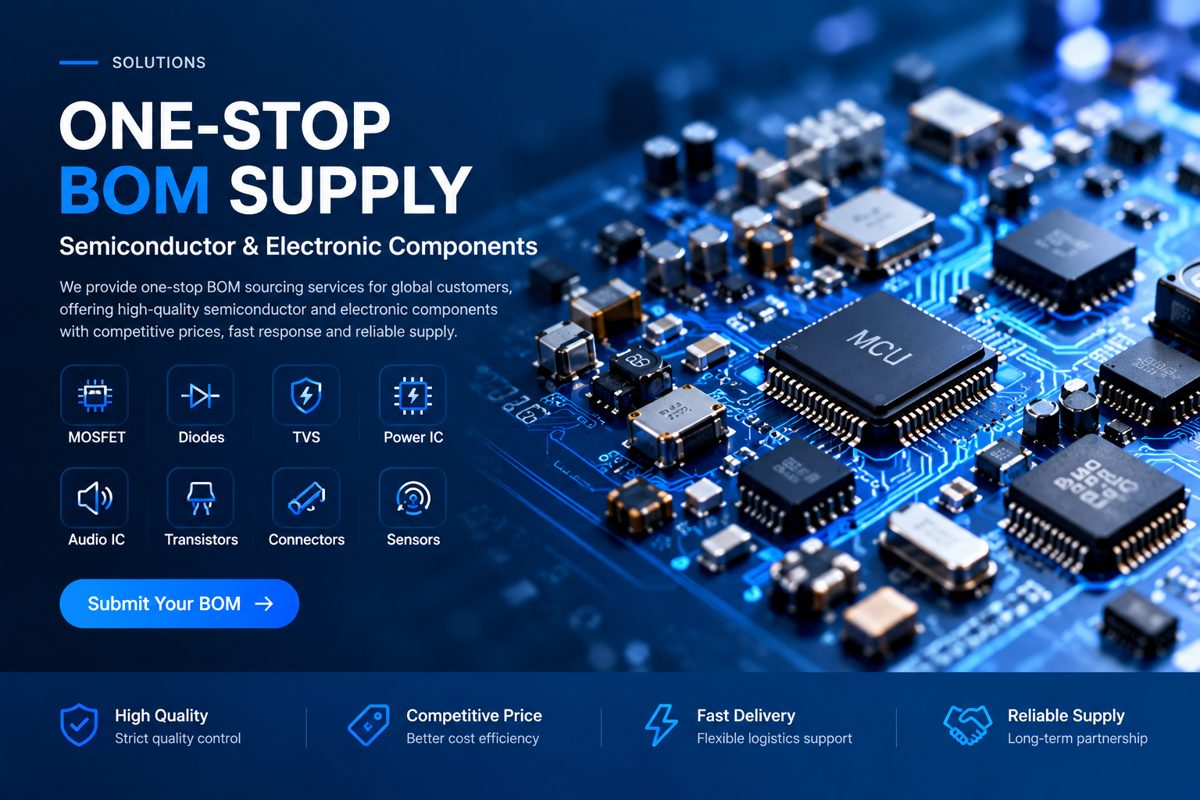
BOM kitting is the work of turning a bill of materials into a single, matched shipment of components, and it is one of the core services we provide from Shenzhen. Since 2013, Haiben has supplied electronic components and assembly support to purchasing teams and hardware engineers, and since 2015 we have exported to customers across North America, South America, Eastern Europe, Southeast Asia, Africa, Oceania, the Middle East, Eastern Asia and Western Europe. Our published service flow runs from customer design input through BOM analysis, component sourcing, PCBA manufacturing, testing and delivery with global logistics support.
What BOM kitting includes
BOM kitting means one-stop matching of a full bill of materials: every line is read, sourced and consolidated so that production receives a complete set rather than a series of partial deliveries from different suppliers. The scope follows the BOM itself. Our one-stop range covers diodes, transistors, MOSFETs, power management and protection ICs, SAW filters, sensors, crystal oscillators, MCUs, EEPROMs, BLE Bluetooth modules, GNSS modules, offline voice-recognition chips and Bluetooth audio chips, and our Solutions pages also list connectors, capacitors, resistors and inductors among the parts we handle. Where a specified part is allocated, obsolete or over budget, our BOM service includes alternative components (equivalents) as part of the kit.
The kitting workflow, step by step
The process begins with design input from the customer: the BOM, quantity plan and any approved alternates. Our BOM analysis then reviews cost and supply risk line by line before sourcing starts. Component sourcing proceeds with cross-reference equivalents where needed, which is also where component sourcing support applies to allocated or hard-to-find lines. For parts that are no longer in active production, our obsolete components service covers identification and equivalent selection. Parts arrive into incoming inspection, the first of our three-stage checks, followed by in-process testing and final delivery inspection before shipment. Logistics follows the Incoterms agreed with the customer, with nearest ports Shenzhen, Guangzhou and Dongguan.
Cost and supply-risk optimisation
Cost and supply-risk optimisation sits at the centre of BOM analysis. It is not simply price comparison: each line is reviewed for availability and lifecycle position as well as unit cost, and equivalents are proposed where they reduce risk without changing function. Standard textbook selection criteria apply — package and pin compatibility, voltage and current ratings, tolerance, temperature range and availability. Our published commercial terms support planning: average lead time within 15 workdays in peak and off-peak seasons, no MOQ for standard parts, and samples available with most standard parts free (freight paid by the buyer and credited against the first order). A 12-month warranty applies, and payment can be made by L/C, T/T, D/P, PayPal or Western Union.
Kitting plus assembly, and how to send a BOM
Because the service flow continues from sourcing into PCBA manufacturing, a kit can move directly into PCB assembly — PCB fabrication, SMT, DIP and programming — then testing, finished product and delivery. Quality is supported by three-stage inspection, stated as full inspection, with 35 senior R&D engineers and 6 quality engineers in the team. To send a BOM, include the full line list with manufacturer part numbers where known, quantities, target build dates and any approved alternates; if the BOM is incomplete or references allocated parts, our analysis stage will flag equivalents before sourcing begins. A complete, clearly dated BOM is the single input that most affects kitting accuracy and lead time.
Frequently asked questions
Is there a minimum order quantity for BOM kitting?
There is no MOQ for standard parts under our published platform terms. Kitting is matched to the quantities in your bill of materials, so a prototype build and a production run are handled through the same workflow.
What happens if a part on my BOM is obsolete?
Our BOM analysis flags it, and our obsolete components service looks for equivalents using standard selection criteria such as package, ratings and tolerance. Any proposed alternative is confirmed with you before it enters the kit.
How long does a kitted order take?
Average lead time is within 15 workdays in both peak and off-peak seasons for the sourcing stage. Total time depends on the BOM, quantities and whether assembly, testing or programming is included, and is confirmed at quotation.
See also: Component sourcing · PCB assembly · Obsolete components