Home / Component Sourcing
Electronic component sourcing services
ServiceGlobal sourcing & stock
Also serves asSemiconductor distributor scope
Lead timeWithin 15 workdays
InspectionThree-stage, full check
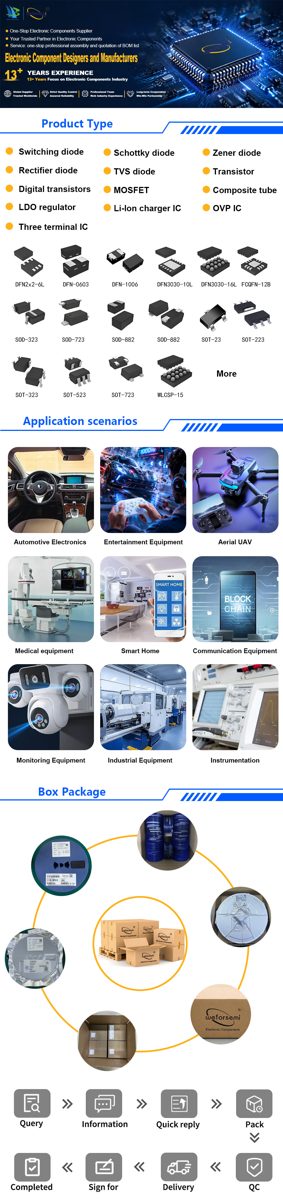
Haiben is an independent electronic components supplier based in Shenzhen, China, founded in 2013 and exporting since 2015. We combine our own stocked range, the Weforsemi line, with global supply channels to support electronic components sourcing for purchasing teams and hardware engineers at electronics manufacturers. This page explains how the sourcing service works, how parts are found, how quality is controlled and what terms apply.
What the sourcing service does
Sourcing starts from engineering input rather than a catalogue number. The published service flow begins with customer design input, followed by BOM analysis with a focus on cost and supply-risk optimisation. From there we source components, including cross-reference equivalents where the original part is unsuitable or unavailable, and can carry the project through PCBA manufacturing — PCB fabrication, SMT, DIP and programming — then testing, finished product and delivery with global logistics support.
The one-stop range covers diodes, transistors, MOSFETs, power management and protection ICs, SAW filters, sensors, crystal oscillators, MCUs, EEPROMs, BLE Bluetooth modules, GNSS modules, offline voice-recognition chips and Bluetooth audio chips. Connectors, capacitors, resistors and inductors are also among the parts handled. Buyers searching for a semiconductor distributor or an IC supplier can use the same channel: our own stocked Weforsemi line sits alongside third-party sourcing, so a single enquiry can cover both standard and harder-to-place items.
Part selection support is part of the service, as is cross-reference equivalent replacement — useful when a design must move to an alternative device without reworking the board. Programs that need a complete kit rather than individual lines are handled through BOM kitting.
Stock plus channels: how a part gets found
A request is first matched against our own inventory, including the Weforsemi line. If the exact part is not held, sourcing moves to established global supply channels, with cross-reference equivalents checked against the design requirements. This two-track approach is what allows an independent supplier to cover both current production parts and older devices that are no longer promoted by their original makers.
For legacy designs, the relevant route is obsolete and hard-to-find parts, where the priority is confirming that the part offered is the correct device for the application. The range of manufacturers we can approach is described on our brands we source & supply page. Where a part is genuinely at end of life, the cross-reference option is raised early so purchasing and engineering can decide together.
Quality control on sourced parts
Sourced parts pass through a three-stage inspection described by the company as full inspection: incoming inspection, in-process testing and final delivery inspection. Incoming inspection is the point at which parts entering from external channels are checked before they are released to a build or to a customer order.
Behind this sit 35 senior R&D engineers and 6 quality engineers (company-stated). For purchasing staff, the practical effect is that a sourced line is verified before it moves downstream, and any issue is raised at the earliest stage rather than after goods have shipped. Engineers evaluating a proposed equivalent should state the critical parameters on the enquiry, so that the cross-reference check is made against the actual circuit conditions.
Terms, lead time and how to enquire
Published platform terms are as follows: average lead time is within 15 workdays in both peak and off-peak seasons; there is no MOQ for standard parts; samples are available, with most standard parts free (freight paid by the buyer and credited against the first order). A 12-month warranty applies. Payment can be made by L/C, T/T, D/P, PayPal or Western Union, and Incoterms offered are FOB, EXW, CFR, CIF and DDP. The nearest ports are Shenzhen, Guangzhou and Dongguan.
Main markets are across North America, South America, Eastern Europe, Southeast Asia, Africa, Oceania, the Middle East, Eastern Asia and Western Europe. To enquire, send the BOM or target part list with quantities, the required lead time and any approved equivalents; the team will respond with availability, equivalent options and a quotation.
Frequently asked questions
Can Haiben supply parts that are not in the Weforsemi line?
Yes. The Weforsemi line is our own stocked range, and it is combined with global supply channels. Requests for third-party brands are sourced through those channels, with cross-reference equivalents proposed where appropriate.
What is the difference between BOM analysis and BOM kitting?
BOM analysis reviews cost and supply risk at the start of a project and identifies equivalent options. BOM kitting assembles the complete set of parts for a build. Both can be combined with PCBA manufacturing and testing.
How are sourced parts checked before delivery?
Parts pass a three-stage inspection stated as full inspection: incoming inspection, in-process testing and final delivery inspection. A 12-month warranty applies to supplied parts.
See also: BOM kitting · Obsolete components · Brands we supply